When a snake can't clear a clogged line, we bring in the hydro jetter — high-pressure water that cuts through what a snake can't. Once the line is flowing, we run a camera down it to see why it clogged, and locate the exact spot and depth of any problem from above ground. You agree to the price for the jetting and diagnostic before we start.
Step 1 — The snake comes first
Most clogs clear with a drain snake. It's fast, and for a simple blockage of hair, soap or paper, it's all you need.
But some lines are packed with grease, scale or roots that a snake can't break through — or it punches a small hole and the line clogs again right away. That's when we go stronger.
Step 2 — Jet: when the snake won't clear it
A hydro jetter sends high-pressure water through a hose with a special nozzle. Rear-facing jets pull the nozzle down the line while they scour the pipe walls, cutting through grease, scale and roots across the full width of the pipe — not just a hole down the middle.
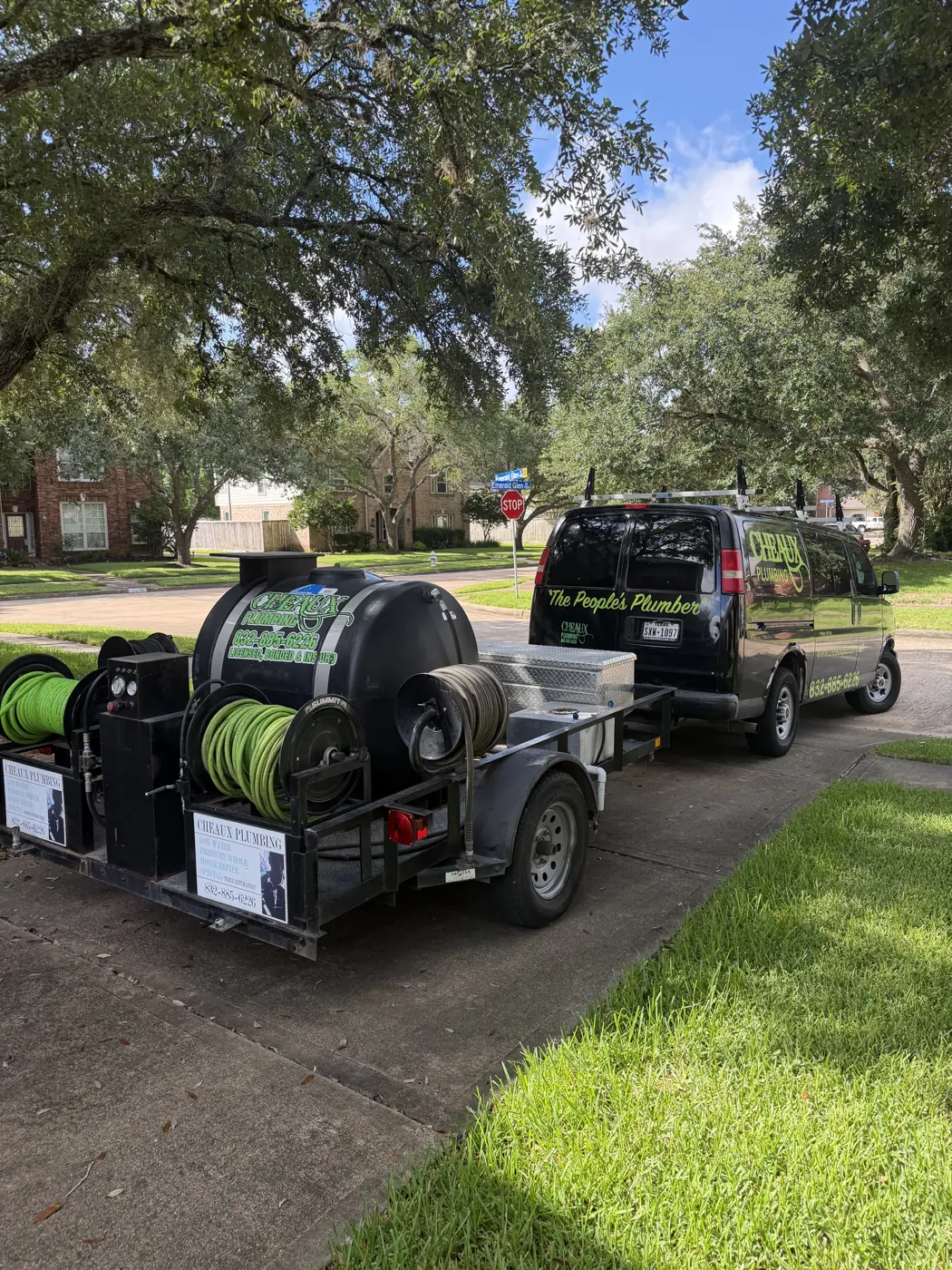
Our jetter is trailer-mounted, so it rolls up to the cleanout and the work happens outside your home or business.
Step 3 — Camera: find out why it clogged
Once the line is clear, we feed a waterproof camera through it. A clog that needed a jetter usually has a reason behind it, and the camera shows what it is:
- Roots growing in through joints or cracks
- Grease and scale buildup on the pipe walls
- Bellies — sags in the line that hold water and debris
- Offsets — joints that have shifted out of line
- Cracks, breaks or collapsed sections
Houston's clay soil swells when it's wet and shrinks in a drought, and lines under a slab move with it. The camera tells you whether the clog was just buildup or a pipe that has shifted or broken — and whether it's likely to happen again.
Step 4 — Locate: mark the exact spot from above
The camera head carries a small transmitter. When the camera reaches a problem, we hold a locator above ground and follow the signal. It tells us where the problem is and how deep it sits, and we mark that spot on the floor, slab or yard.
This matters most on a slab foundation. If a repair is needed, it starts at the marked spot instead of a guess — less concrete broken, less yard dug up.
What it costs and how it works
Before we start, you agree to a price for the jetting and the camera diagnostic. When we're done, we show you the footage, tell you what we found, and if the line needs a repair, you get a straight quote for that work.
Signs you need jetting and a camera
- A snake didn't clear the line, or it clogged again soon after
- More than one fixture backs up at the same time
- Gurgling from toilets or drains when water runs elsewhere
- Sewage smell inside or around the house
- Slow drains throughout the home
- A restaurant or commercial kitchen with grease buildup
When the camera finds a broken pipe
Jetting clears a line — it can't fix a broken one. If the camera shows a crack, a collapsed section or a bad belly, the line will keep giving trouble until that section is repaired. Because it's already located and marked, the repair goes straight to the problem.
Questions
Why not just use a snake?
We do try the snake first. When a snake can't clear the line — or the line clogs again right away — the hydro jetter cleans the full width of the pipe so it stays clear.
Why run a camera after the line is clear?
A clog bad enough to need a jetter usually has a cause: roots, a sag, a shifted joint or a break. The camera shows what it is so you know whether it will come back.
Do I need a cleanout?
A cleanout makes it easiest. Without one we can sometimes go in through a toilet or roof vent, or install a cleanout so the line is easy to service from then on.